Restoring stability is an important part of biological knee replacement.
First published 2010 by Dr Kevin R Stone, and reviewed August 2023 by Dr Sheila Strover (Clinical Editor)
Options for damaged knee ligaments in biologic knee replacement
Restoring stability is an important part of biological knee replacement.
First published 2010 by Dr Kevin R Stone, and reviewed August 2023 by Dr Sheila Strover (Clinical Editor)
We approach that in the following way –
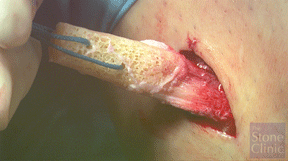
We have posted a video called ‘Knee dislocation, reconstruction of the ACL, PCL and posterolateral corner' on our website for people to see, but in general we will use a sterilised bone patellar-tendon bone allograft (photo on right) for the ACL and for the PCL, and for the posterolateral corner we will use a sterilised anterior tibialis tendon which we pass through the fibular head, underneath the skin and underneath the iliotibial band and up to a small incision through the iliotibial band to the anatomic insertion site.
For reconstruction of ruptured ligaments in the knee when we are doing a biological joint reconstruction, we don’t want to sacrifice any of the patient’s own tissue if it is not necessary. Up until about 5 years ago we felt as though allograft tissues were not as reliable as autograft tissues.
Once we were able to obtain sterilised allograft tissues whose biomechanical properties had not been damaged by the sterilisation process then we felt comfortable moving forward to use those tissues in replacement of autogenous tissues. We did not want to ‘rob Peter to pay Paul’, that is we did not want to damage one part of the knee in order to rebuild another part of the knee. Over the last 5 years our results of allograft tissue have matched our autograft tissue except that the patients have much less pain and a much faster rehabilitation.