 In this illustration, the
 A plica is a normal structure
A plica is something one is born with, and it may never give cause for concern. Sometimes, however, it may start to cause symptoms, perhaps after being traumatised and becoming a bit inflamed and thickened.
Then it may become nipped between the moving structures of the knee, commonly the femur and patella, and cause intermittent pain.
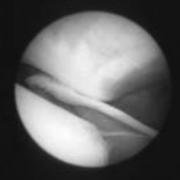
Arthroscopic photograph showing a thickened plica being nipped.
Peer-reviewed paperQuote from peer-reviewed paper:
"....the medial plica is the most commonly symptomatic one....Depending on its position, size, and elasticity, the plica may impinge between the quadriceps tendon and femoral trochlea at 70 to 100 degrees of knee flexion, causing mechanical symptoms."
Citation: Lee PYF, Nixion A, Chandratreya A, Murray JM. Synovial Plica Syndrome of the Knee: A Commonly Overlooked Cause of Anterior Knee Pain. Surg J (N Y). 2017 Feb 15;3(1):e9-e16. doi: 10.1055/s-0037-1598047. PMID: 28825013; PMCID: PMC5553487.
How does one diagnose a symptomatic plica?
The patient's story is often suggestive - periodic sudden painful catching in the knee, usually on the medial side of the patella.
Examination may show a positive stutter test, where the examining fingers placed over the affected area may feel a musclular 'stutter' as the knee, hanging over the edge of the examination coach, is bent and straightened. A problematic plica may be seen on arthroscopy, and there may be a split or other damage on the joint cartilage on either side. Finally, the problem may be evident on MRI scan.
Peer-reviewed paperQuote from peer-reviewed paper:
"....The most frequent complaint was supra-patellar pain and cracking noises following the performance of physical activity of a type or intensity of which the patient was unaccustomed."
Citation: Camanho GL. Treatment of pathological synovial plicae of the knee. Clinics (Sao Paulo). 2010 Mar;65(3):247-50. doi: 10.1590/S1807-59322010000300002. PMID: 20360913; PMCID: PMC2845763.
Symptomatic plicae often mimic other conditions
Plicae are normal anatomical structures, so they are often ignored when the surgeon is investigating the problematic knee.
They may cause clicking and catching and be mistaken for a meniscus problem, for example. But usually a careful arthroscopic examination will reveal thickening at areas that are being impinged or a bit of redness and some damage to underlying joint cartilage.
Forum discussions
- "Re: Extremely Frustrated and Losing Hope"
A discussion that includes issues of cutting a plica.