 .
.
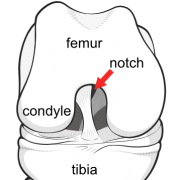
What is the importance of the intercondylar notch?
The intercondylar notch of the femur serves to house and protect the two cruciate ligaments that tether femur and tibia centrally.
The cruciate ligaments in the notch are critical knee stabilisers, and they are configured to allow bending and flexing of the knee in a simple arc, despite the fact that the condyles are more oval than round. A narrow notch, however, may predispose to cruciate ligament damage, especially in athletes, and such a risk may be evaluated by MRI scans.
The notch also provides a passage for surgeons to view the back of the knee by passing their instruments through it to view the area of the popliteus hiatus on the lateral side and both posterior meniscal roots.
Peer-reviewed papersQuote from peer-reviewed paper:
"....ACL tears are associated with a small intercondylar notch width and a high α angle...."
Citation: Fernández-Jaén T, López-Alcorocho JM, Rodriguez-Iñigo E, Castellán F, Hernández JC, Guillén-García P. The Importance of the Intercondylar Notch in Anterior Cruciate Ligament Tears. Orthop J Sports Med. 2015 Aug 5;3(8):2325967115597882. doi: 10.1177/2325967115597882. PMID: 26535388; PMCID: PMC4622305.
Decisions regarding the notch during cruciate ligament reconstruction and revision
After cruciate ligament reconstruction, the new graft may be relatively fatter than the original, and may impinge on the roof of the notch as the knee goes into full extension.
This can precipitate a surgical dilemma. Should the surgeon widen the notch to accommodate the graft (notchplasty), but risk bleeding (haemarthrosis) and alter the joint's biomechanics? Haemarthrosis may in its own right lead to inflammation, problems with rehabilitation and arthrofibrosis (internal scarring).
Peer-reviewed papersQuote from peer-reviewed paper:
Surgeons are advised to avoid notchplasty in the first reconstruction because of.... "risks related to notchplasty during primary ACLR, reserving it for the surgical management of arthrofibrosis, the presence of notch osteophytosis, and revision surgery"....
Citation: Ranuccio F, Familiari F, Tedesco G, La Camera F, Gasparini G. Effects of Notchplasty on Anterior Cruciate Ligament Reconstruction: A Systematic Review. Joints. 2017 Aug 8;5(3):173-179. doi: 10.1055/s-0037-1605551. PMID: 29270549; PMCID: PMC5738469.
Cyclops lesion or cyclops syndrome?
A graft reconstruction that is too fat may limit extension and may also cause some stripping back of the graft construct, creating a lump of tissue called a 'cyclops lesion'.
Again, this may present a surgical dilemma, as a cyclops lesion may become big enough to obstruct knee extension.
Peer-reviewed papersQuote from peer-reviewed paper:
" ....it is important to distinguish between cyclops lesion and syndrome, as management differs based on symptoms....cyclops syndrome causes loss of terminal extension...."
Citation: Kambhampati SBS, Gollamudi S, Shanmugasundaram S, Josyula VVS. Cyclops Lesions of the Knee: A Narrative Review of the Literature. Orthop J Sports Med. 2020 Aug 28;8(8):2325967120945671. doi: 10.1177/2325967120945671. PMID: 32923503; PMCID: PMC7457408.