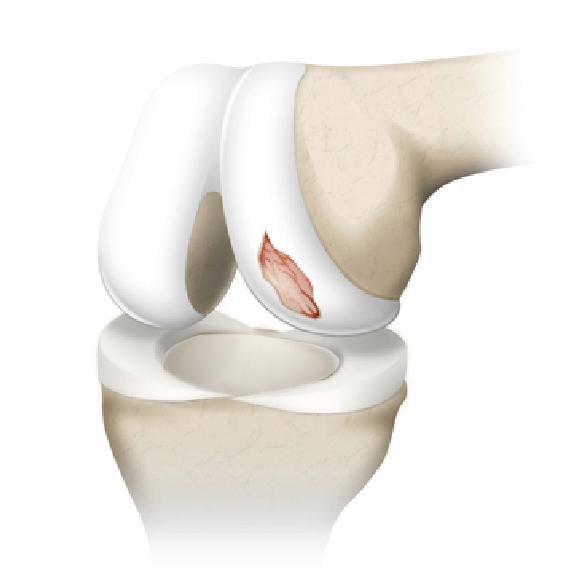
Articular cartilage injury on a weight-bearing part of the femoral condyle.
Articular cartilage repair is the repair or improvement of defects of the joint cartilage, either by surgery or biological intervention, or both. Page updated May 2024 by Dr Sheila Strover (Clinical Editor)
Articular cartilage injury on a weight-bearing part of the femoral condyle.
Damage may range from a softening of the cartilage (chondromalacia), to a full thickness lesion (chondral defect), and a chunk of material may even be knocked off into the joint cavity (loose body).
Peer-reviewed papersQuote from peer-reviewed paper:
Citation: Solanki K, Shanmugasundaram S, Shetty N, Kim SJ. Articular cartilage repair & joint preservation: A review of the current status of biological approach. J Clin Orthop Trauma. 2021 Sep 21;22:101602. doi: 10.1016/j.jcot.2021.101602. PMID: 34631411; PMCID: PMC8488240.
Injury means that the cartilage does not heal well, and even where there is some healing the area tends to produce 'fibrocartilage' rather than true articular cartilage.
This has given rise to a number of special techniques involving bringing in blood components from the deeper sub-chondral layer, and also transferring healthy cells grown in a laboratory or tissue pieces transferred from other healthy areas where they are not so important.
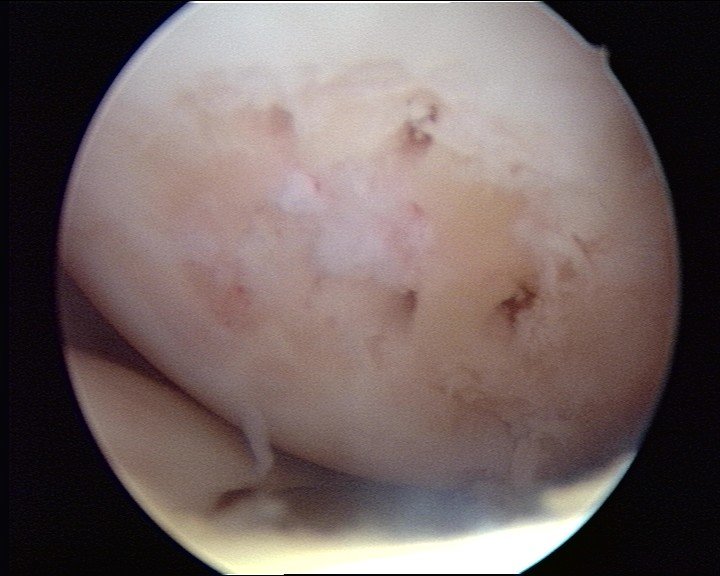
Microfracture for articular cartilage repair is a marrow stimulation technique, where holes are picked through the cartilage base plate, to allow blood and cells to track through into the defect.
The procedure may be performed in isolation, or in addition to another cartilage repair procedure.
Nanofracture is a variant of this original procedure, using smaller picks.
 Procedures like mosaicplasty involve plugs of healthy cartilage being transferred from one area to another
Patients discuss whether insurers will pay for cartilage repair procedures.
Patients discuss how to protect the cartilage repair while rehabilitating.
