Trochlear dysplasia

Written by Dr Sheila Strover on March 14, 2025

Trochlear dysplasia is a condition of the knee where the  trochlear groove is abnormal, usually at its upper end where it is abnormally flat or even heaped into a 'bump'. Page updated May 2024 by Dr Sheila Strover (Clinical Editor)

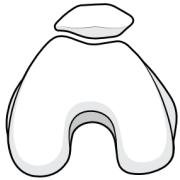
mild trochlear dysplasia with shallow trochlea

Illustration looking at the knee from the front, with the trochlear groove in profile at the top of the condyles. Shows mild trochlear dysplasia - with a shallow trochlear groove.

trochlear dysplasia with a flat upper trochlea with no groove

Same view illustrating a more severe situation where the upper trochlea has no groove at all.

trochlear dysplasia with a trochlear bump

Same view showing severe trochlear dysplasia. Instead of being convex, the trochlear at its upper end forms a concave 'bump', and the patella finds no comfortable groove with which to engage.

What causes trochlear dysplasia?

Trochlear dysplasia is simply something one is born with. Very rarely it can be attributed to damage to the patella in a young child.

Peer-reviewed paper
  • Quote from peer-reviewed paper:

    "....the shape of the trochlea is largely maintained during growth and development and does not change significantly after birth....

    Citation: Onor GI Jr, Yalcin S, Kaar SG, Pace JL, Ferrua P, Farrow LD. The Evaluation of Trochlear Osseous Morphology: An Epidemiologic Study. Orthop J Sports Med. 2021 Apr 2;9(4):2325967121994548. doi: 10.1177/2325967121994548. PMID: 33869646; PMCID: PMC8020235.

End of paper

Back to top

Trochlear dysplasia and kneecap instability

Trochlear dysplasia is commonly associated with an unstable patella (kneecap), and patellar subluxation or dislocation.

Peer-reviewed paper End of paper Quick links

Classifying trochlear dysplasia

Classification systems exist to document the degree of abnormality.

Peer-reviewed paper End of paper Quick links

Patellar instability near full extension

Classically with severe trochlear dysplasia the patient experiences there may be a visible subluxation near full extension, where the patella suddenly slips laterally. This is called the 'J-sign'.

Back to top

Forum discussions

Back to top