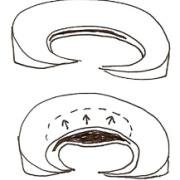
With walking, the clam-like split may allow fluid to enter, but a valve-action hinders it from leaving. Fluid pressure builds up inside the cavity.
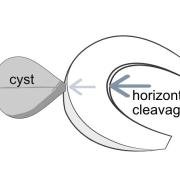
Eventually the fluid pushes out the outer rim of the meniscus.
A meniscal cyst is a fluid-filled tender lump at the joint line of the knee, arising from the meniscus shock absorber. Page updated June 2024 by Dr Sheila Strover (Clinical Editor)
With walking, the clam-like split may allow fluid to enter, but a valve-action hinders it from leaving. Fluid pressure builds up inside the cavity.
Eventually the fluid pushes out the outer rim of the meniscus.
The sliding motion of the upper and lower part of the meniscus can trap fluid in the cleavage, and then the lip can close like a clam so that pressure of the fluid inside the cleavage forces a passage through to the outside of the meniscus.
Peer-reviewed papersQuote from peer-reviewed paper:
Citation: Crowell MS, Westrick RB, Fogarty BT. Cysts of the lateral meniscus. Int J Sports Phys Ther. 2013 Jun;8(3):340-8. PMID: 23772349; PMCID: PMC3679639.
External rotation of the tibia may cause the lateral mass to become more prominent, while internal rotation of the tibia may cause the mass to completely disappear. Ultrasound may be useful in establishing the presence of fluid in the lump, and the diagnosis can be confirmed with MRI.
Peer-reviewed papersQuote from peer-reviewed paper:
Citation: Chen H. Diagnosis and treatment of a lateral meniscal cyst with musculoskeletal ultrasound. Case Rep Orthop. 2015;2015:432187. doi: 10.1155/2015/432187. Epub 2015 Feb 5. PMID: 25722908; PMCID: PMC4334430.
Quote from peer-reviewed paper:
Citation: Haratian A, Bolia IK, Hasan LK, Fathi A, Solaru S, Homere A, Petrigliano FA, Weber AE. Arthroscopic Management of Meniscal Cysts: A Systematic Review. Orthop Res Rev. 2021 Sep 17;13:123-139. doi: 10.2147/ORR.S321893. PMID: 34557043; PMCID: PMC8455512.
Patient discussing issues after meniscal cyst surgery.