Arthrofibrosis

Written by Dr Sheila Strover on March 14, 2025

Arthrofibrosis of the knee is a complication of injury or surgery where an excessive scar tissue response leads to painful restriction of knee motion. Page updated March 2024 by Dr Sheila Strover (Clinical Editor)

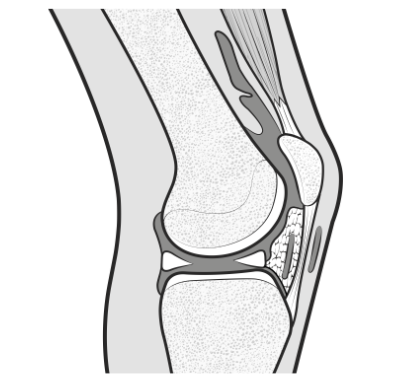
normal knee, before onset of arthrofibrosis

This illustration shows a knee that has been cut open vertically. Normally the soft tissue folds are lubricated and allow easy bending and straightening of the knee. The kneecap (patella) will be quite mobile.
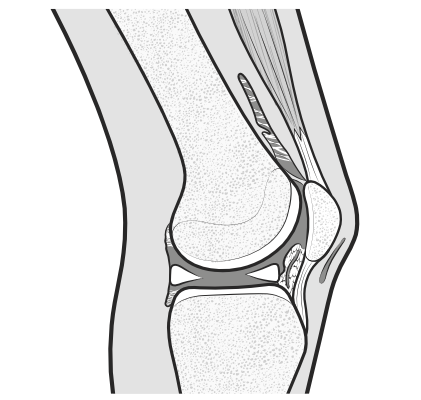
sites of arthrofibrosis in the knee

Inflammation in the soft tissues above and below the kneecap triggers sticky adhesions gluing up the tissue folds
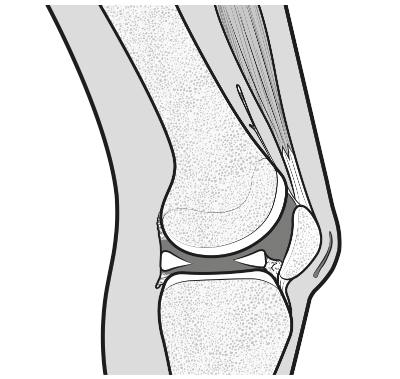
Advanced arthrofibrosis of the knee

In arthrofibrosis these adhesions mature into scar tissue, which contracts and locks up the joint

What triggers knee arthrofibrosis?

The arthrofibrotic process is triggered by inflammation most commonly affecting the fat pad behind the patellar tendon.

Then adhesions develop start to stick down the soft tissue folds of the suprapatellar pouch, posterior capsule and anterior interval underneath the tendon. This may result in flexion loss, extension loss or both. Matured scar tissue then contracts, closing the important spaces that normally allow movement, and pulling the kneecap right down (patella baja or infera), where every movement is painful.

Quick links

How common is knee arthrofibrosis?

Problems due to arthrofibrosis are uncommon but are usually consequent on significant knee surgery or injury

Significant surgery might include a multiligament reconstruction or total knee replacement, or there might have been a bad knee injury where the joint has had to be immobilised. A particular trigger is a large bleed inside the knee (haemarthrosis), with painful swelling of the joint.

Because true arthrofibrosis is not common, the importance of the symptoms may not be recognised and managed early during the physiotherapy phase. By the time the management team recognise that this process has been triggered, it may be difficult to manage.

Quick links

What symptoms suggest the onset of early arthrofibrosis?

The patient may have felt confident starting rehabilitation exercises but then may have experienced progressive problems bending the knee, and these early attempts may be excessively painful.

'Pushing through the pain' may simply make things much worse, triggering more inflammation and swelling, and further limiting range of motion. The joint may feel warm to the touch.

Quick links

Symptoms of advanced arthrofibrosis and patella baja

As the soft tissues behind and below the kneecap become involved in the scar tissue process, the kneecap may be pulled into an abnormally low position (patella baja or patella infera)

The abnormal position of the patella may result in considerable pain when trying to walk, and the knee may be most comfortable in a slightly bent position.

Peer-reviewed papers
  • Quote from peer-reviewed paper:

    "...two subtypes of arthrofibrosis occur....one involving active scar formation, and one in which inflammatory processes have resolved....each should be treated differently."

    Citation: Usher KM, Zhu S, Mavropalias G, Carrino JA, Zhao J, Xu J. Pathological mechanisms and therapeutic outlooks for arthrofibrosis. Bone Res. 2019 Mar 26;7:9. doi: 10.1038/s41413-019-0047-x. PMID: 30937213; PMCID: PMC6433953.

End of papers

Back to top

Rehabilitation issues with arthrofibrosis

Early range of motion problems can be reversed with empathetic management - ideally patellar mobilisation and range of motion exercises in combination with adequate pain relief - without pushing the joint into painful inflammation that makes things worse.

Manipulation under anaesthesia may help to break adhesions before they become permanent scar tissue. Advanced arthrofibrosis with marked knee stiffness may need surgical lysis of adhesions to regain range of motion, in combination with specialist pain management and physiotherapy.

Peer-reviewed papers End of papers Quick links

Forum discussions about arthrofibrosis

Back to top