Patella baja

Written by Dr Sheila Strover on March 14, 2025

Patella baja is a kneecap that is positioned abnormally low in relation to the groove of the femur. It is also known as patella infera or infrapatellar contracture syndrome. Page content approved May 2024 by Dr Lars Blond (Knee Surgeon)

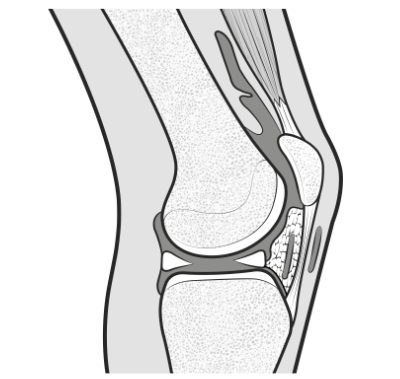
normal knee, before onset of arthrofibrosis

Side view of section through a normal knee, where there are no adhesions locking up movement.
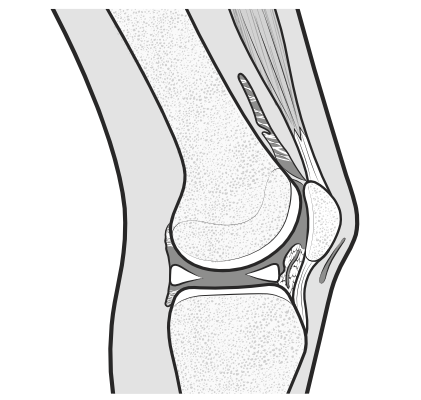
sites of arthrofibrosis in the knee

Adhesions developing in the suprapatellar pouch, posterior capsule and anterior interval may create flexion loss, extension loss or both.
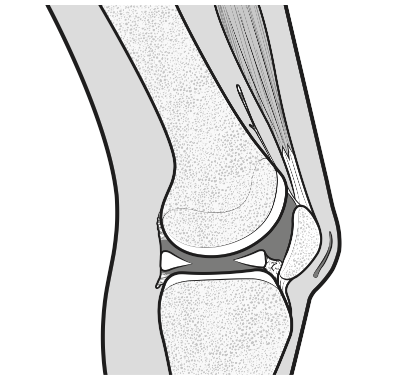
Advanced arthrofibrosis of the knee

Matured scar tissue has contracted, closing the important spaces that normally allow movement, and pulling the kneecap right down.

Who gets patella baja?

Some people are born with an atypically low patella, but more often patella baja or patella infera is a complication of injury or surgery.

An abnormally low patella - patella baja (also called patella infera) - is a common complication of total knee replacement or opening-wedge tibial osteotomy due to inflammation and scarring within the front of the knee joint and behind the patellar tendon - in the region known as the anterior interval.

It may also be seen in any other condition where 'arthrofibrosis' has been triggered in the anterior interval, such as following joint infection or a long period of knee immobilisation, after quadriceps muscle weakness, fractures of the tibia, and any other cause of arthrofibrosis inside the knee.

Quick links

What are the consequences of patella baja

The abnormal position causes more pressure onto the edge of the kneecap, which may lead to considerable pain, as the kneecap impinges against the tibia when the knee bends - and arthritic changes can occur at the back of this bone.

If patella baja is not adequately managed it can lead to decreased range of motion (ROM) in both flexion and extension, inability to fully straighten the knee, impingement with anterior knee pain and possibly rupture of the patellar tendon.

patella baja after arthrofibrosisThis image is of an extreme case of patella baja (one of our knee forum patients!) where the tissues below the patella repeatedly became 'stuck down', eventually requiring radical surgery of cutting the patellar tendon, mobilising the knee until it was quiet, and then grafting the tendon!

Back to top

Monitoring patella baja

Because the scarring of arthrofibrosis of the anterior interval tugs the patella down, serial X-rays of kneecap position can help the surgeon to evaluate deterioration in the arthrofibrotic condition and the need for surgical intervention, such as lysis of adhesions and anterior interval release.

Quick links

Interventions for patella baja

By the time patella baja has developed, it is likely already too late for interventions such as patellar mobilisations and manipulation under anaesthesia.

The surgeon may try to surgically release the scar tissue with anterior interval release. If these measures fail, and the patient remains symptomatic, surgical options may include:

Peer-reviewed papers
  • Quote:

    "Treatment strategies include tibial tubercle proximalization, patellar tendon lengthening, and patellar tendon reconstruction. Allografts and autografts can be utilized..."

    Citation: Barth KA, Strickland SM. Surgical Treatment of Iatrogenic Patella Baja. Curr Rev Musculoskelet Med. 2022 Dec;15(6):673-679. doi: 10.1007/s12178-022-09806-y. Epub 2022 Nov 29. PMID: 36445621; PMCID: PMC9789255.

End of papers

Back to top

Forum discussions

Back to top