- are superficial
- span two joints
- are often involved in eccentric activity, ie actively lengthening, generally for deceleration movement
- have special 'quick response' (Type II) muscle fibres
Three categories of acute injuries to the muscle-tendon unit have been defined: muscle contusion, myotendinous strain, and tendon avulsion (ref 3). Diagnosis may be clinically straightforward through the history and the physical examination but sometimes it may be necessary to use MRI to identify the exact point and nature of the damage.
Muscle contusions are very common injuries and usually occur from a direct blow to the muscle. You may also find these injuries called muscle bruises or muscle haematomas.
When there is a direct blow to muscle a local compression injury can occur and bleeding results. There are two types of muscle bleeding or haematoma as outlined in the table below.
- Intramuscular haematoma - Bleeding within a muscle. Muscle sheath keeps blood in muscle and increases pressure in the muscle. Swelling lasts more than 48 hours as blood can't escape.
One of the complications associated with muscle contusions is called myositis ossificans (bone growth within the muscle). Myositis ossificans occurs when blood from an intramuscular haematoma calcifies and turns into bone tissue in the muscle that shows up on x-ray.
- Intermuscular haematoma - Bleeding between muscles. Swelling and bruising 24-48 hours after injury but often further down leg from injury due to gravity. Initial swelling decreases quickly. Generally not as severe as an intramuscular haematoma.
Myotendinous Strain
Muscle strains (commonly called pulls or tears) occur when forces are greater than the strength of the muscle and the muscle fibres tear. This usually occurs at the weakest point in the chain and this is often at the MTJ where elastic muscle merges with the tougher, more fibrous connective tissue of the tendon. Acute muscle strains generally occur with a single excessive force that often occurs when a muscle is trying to resist being stretched, for instance in fast deceleration.
Muscle strains are classified into three grades according to the severity of the injury.
- Grade I (1st degree) - Mild strain. Minor degree of muscle fibre disruption (less than 5% of fibres). Localised pain but no great loss of strength or restriction of movement.
- Grade II (2nd degree) - Moderate strain. More muscle fibres are torn but not a total tear of the muscle. Pain on trying to use the muscle and swelling. Strength is reduced and movement is restricted.
- Grade III (3rd degree) - Severe strain. Complete rupture of the muscle. Unable to use the muscle at all. The muscle may appear 'bunched up'.
Tendons are twice as strong as muscle tissue but that doesn't mean that they can't be torn and both partial tendon ruptures and complete tendon ruptures can occur.
Complete tendon ruptures tend to occur in older people when the tendon has degenerated and isn't able to resist the same level of forces. If a complete tendon rupture occurs the person may feel a sudden snap and pain at the time of injury and as the muscle is no longer attached to the skeleton the normal movement for that muscle no longer occurs. The tendons in the lower limb that are more prone to complete rupture are the Achilles tendon, the quadriceps tendon and the patellar tendon.
If only some of the tendon fibres are torn it is classed as a partial tendon rupture. These are associated with sudden pain both in the area where the damage occurred plus during the movement that uses that particular muscle-tendon unit. There is likely to be swelling but not as much as a partial muscle strain as tendon blood supply is poor compared to muscle.
Because of the forces that tendons have to resist during normal everyday activities a tendon rupture is likely to need to be immobilised or require surgical repair even if it is not a complete rupture.
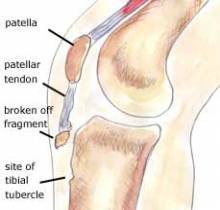
Tendon avulsions are where a tendon is torn off its attachment to the bone often taking the periosteum and a little fragment of bone with it. As a piece of bone is broken off with the tendon these injuries are generally classed as a type of fracture.
A tendon avulsion injury is often more serious than a muscle contusion or myotendinous strain. These injuries are more common in adolescents and children as the muscles and tendons are stronger than the bone. This is the opposite in adults where, normally, bone is stronger than muscle and tendon.
References
Click on the reference to open abstract.
1 Garrett, W. Muscle strain injuries, Am J Sports Med. 1996;24(6 Suppl):S2-8.
2 Jarvinen, T.A. et al. Muscle strain injuries. Curr Opin Rheumatol. 2000 Mar;12(2):155-61.
3 Bencardino, J.T. et al. Traumatic musculotendinous injuries of the knee: Diagnosis with MR imaging, Radiographics 2000;20:S103-S120.

