
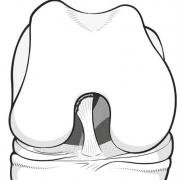
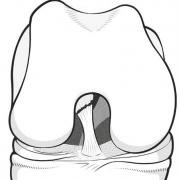
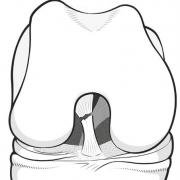
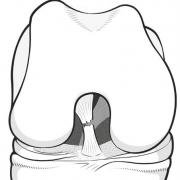
The ideal patient for a repair has a Sherman Type I injury with a femoral detachment and a good quality ACL remnant, where the injury is fairly acute (less than 6 weeks or a healthy stump if stuck to the PCL).
The Sherman classification is as follows:
The historical background
Cruciate ligament surgery has a long and fascinating history, and the story continues to evolve.
In fact, in our own time the decade of the 1980s is sometimes referred to as 'the lost decade'. This is the decade when keyhole surgery (arthroscopy) was developed, and knee surgeons started to develop clever tools and new systems for reconstructing cruciate ligament tears via tiny keyhole incisions. However it coincided with a movement to use artificial materials, and surgeons argued a lot about the best position for the tunnels - and many of these operations ultimately failed.
Nowadays there is much more of a consensus, with most unstable ligament tears being reconstructed using hamstrings tendon.
Sherman, when he described his Sherman System of classification, was interested in the idea of repairing rather than reconstructing the torn cruciate ligament, a concept that is beginning to regain favour as better materials and techniques continue to evolve.
References
Sherman MF, Lieber L, Bonamo JR, Podesta L, Reiter I. The long-term followup of primary anterior cruciate ligament repair. Defining a rationale for augmentation. Am J Sports Med. 1991 May-Jun;19(3):243-55.
Sherman MF, Bonamo JR. Primary repair of the anterior cruciate ligament. Clin Sports Med 1988; 7:739–750