Patellar mobilisations are important in knee rehabilitation in order to prevent later stiffness of the joint.
First published 2007, and reviewed August 2023 by Dr Sheila Strover (Clinical Editor)
Patellar mobilisation
Patellar mobilisations are important in knee rehabilitation in order to prevent later stiffness of the joint.
First published 2007, and reviewed August 2023 by Dr Sheila Strover (Clinical Editor)
Increased forces between these joints can lead to accelerated wear on the joint cartilage.
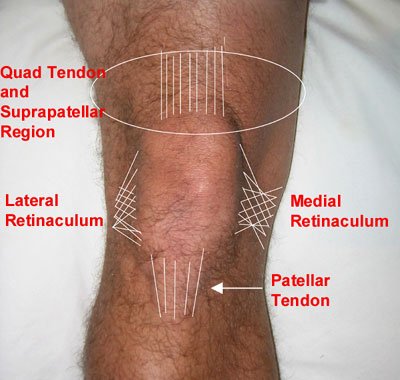
Assessment of the patella should be done by shifting or gliding the patella in different directions. Our assessment includes:
Contraindications -
These are reasons NOT to mobilize (unless it has been cleared by your doctor or physical therapist)
Patella and tendon mobilizations are done to discourage adhesions from limiting motion (post-surgical) or to mobilize adhesions that have already formed to promote better mobility (post or non-surgical). When mobilizing your patella, or doing this for someone else, follow these guidelines:
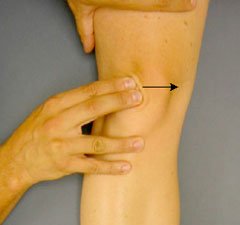
When the lateral retinaculum is tight, you may feel that the patella tilts away from the center line. The opposite structures become mobilized when you move the patella laterally. These structures include the lateral retinaculum, lateral portion of the quad and patellar tendon tendons.
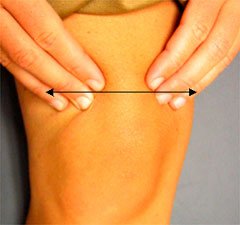
To mobilize the patella medially, place your fingers on the lateral border of the patella. This can be found by feeling for the edges of the patella with your fingers. Bring your fingers to the edge of the bone until they can not go any further to lateral edge. Now push the patella medially. Assess the amount of excursion of the patella.
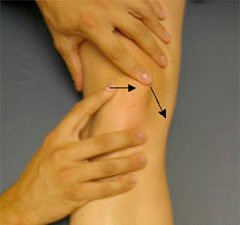
When the lateral retinaculum is tight, you may feel that the patella tilts toward you. Decreased mobility or tilting of the patella is an indication to mobilize in this direction. A combination of a medial glide and medial tilt is pictured.
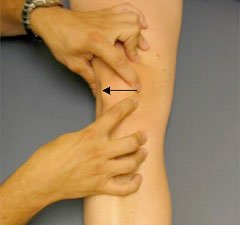
You can mobilize the patella laterally in much the same way as the medial glide by placing your fingers on the medial border of the patella and gliding it to the outside (laterally).
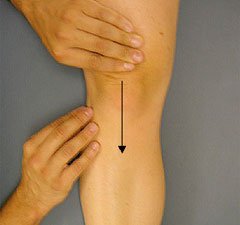
Place your fingers on the top border of the patella. If you are self-mobilizing, you may choose to use the heel of your hand. Gently push the patella toward the foot (inferiorly) until it can not go any further. This mobilization usually feels as though it moves less than the medial or lateral glide.
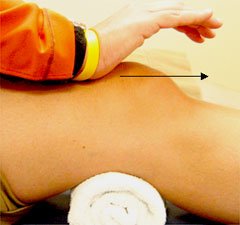
It can be helpful to place a towel roll under your knee in order to bend the knee slightly. This helps to gain more access to the patella, however it will tighten the structures that restrict patellar motion a bit. I find that a slight bend allows for a better mobilization in this direction.
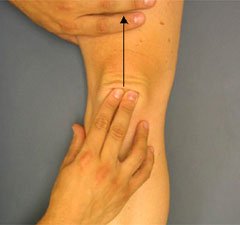
The superior glide is very similar to the inferior glide except that you glide the patella toward your head (superiorly). A slight bend in the knee using a towel roll as described with the inferior glide is helpful with this mobilization too.
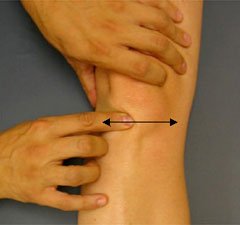
The patellar tendon is soft tissue that connects the tibia bone to the patella. It attaches to the apex of the patella -the lower border - and the tuberosity of the tibia bone - the bony bump you can feel under the patella. Its function is to offer a means of extending the knee through force applied from the quad muscles. The region around the patellar tendon is a common area of scarring.
To find the patella tendon, locate the medial and lateral border of the patella and follow it to downward to the lower portion of the patella. When you can not feel the bone of the patella anymore, feel for a soft, cord-like structure. If you tighten your quad muscles, you will feel the tendon become taught. This is a way to check if you are on the right structure.
Place one finger lateral to the tendon and the other medial. Push the tendon side to side (lateral to medial) to its maximal excursion.
The quad tendon connects the quad muscles to the patella. It lies over the suprapatellar pouch, which is an extension of the knee joint capsule. This is an area where swelling usually appears first.
To mobilize these structures, place your fingers above the patella and move the tissue side-to-side, as if you are massaging the muscle just above the patella. The quad tendon and the suprapatellar pouch are not easy structures to palpate and are not very distinct from one another. With this in mind, do not be discouraged if you do not feel much when you are mobilizing here.