Poor choice of fixation
The type of fixation is to a large extent dictated by whether or not the harvested graft has a bone block -
Grafts with a bone block at either end
The most advantageous graft in terms of fixation is the bone-patellar tendon-bone graft, as when this construct is harvested, it is attached firmly to a block of bone at each end. The bone block is usually held fast in the bone in the tunnels by an interference screw, and this usually gives adequate fixation until the bone block unites with the surrounding bone at about 6 weeks. The femoral bone block is usually positioned close to the tunnel opening into the joint, so that there is no abrasion of the ligament on the edges of the tunnel (windscreen wiper effect).
Grafts with no bone block
Hamstrings tendon grafts (usually these days termed a "four-strand" hamstrings", where harvested semitendinosus and gracilis tendons are laid side-by-side and then folded over to make four strands), do not have such bone blocks, and there is a risk of damaging the soft tissue ends of the graft by the fixation device chosen.
If one considers firstly the fixation on the femoral end of the graft, there are a number of choices -
Fixation on the outside of the bone (cortical fixation), eg Endobutton
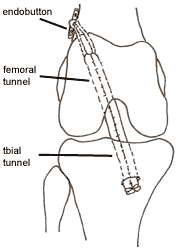
The Endobutton is a thin oblong button. It is attached at its centre to a thread which is itself looped through the end of the graft. The button can be pulled along the tunnel until the tunnel emerges, and then it is turned on its side and locks itself against the wall of bone.
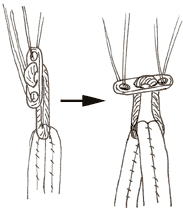
Fixation through the substance of the bone (transfixation), eg Transfix
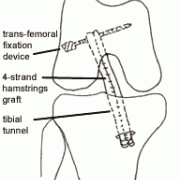
At the femoral outlet, a Transfix bar passed through the loop can hold the upper (proximal) end in position, but where the graft emerges into the joint it is unfixed and may 'windscreen wipe' over the bony edge of the tunnel. This is also the case with the endobutton.
Fixation via the tunnel (interference fixation), eg RCI interference screws
An interference screw is screwed alongside the graft within the tunnel itself, pushing the graft against the back wall of the tunnel.
Tibial side
Tibial fixation may be achieved with a screw and washer system or an interference screw.