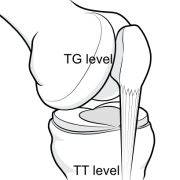
TG = trochlear groove, and for the measurement it is identified via the scans at its deepest point. TT = tibial tubercle, where the patellar tendon attaches.
TT-TG distance is a measurement, derived from CT or MRI scans, which gives an indication of the sideways alignment of the groove in which the kneecap slides compared to the attachment point of its tendon on the tibia. Page updated May 2024 by Dr Sheila Strover (Clinical Editor)
TG = trochlear groove, and for the measurement it is identified via the scans at its deepest point. TT = tibial tubercle, where the patellar tendon attaches.
Since the patellar tendon is attached at its lower end to the tibial tubercle, but runs along the groove as the knee bends and straightens, it is clear that a greater TT-TG distance puts strain on the whole structure.
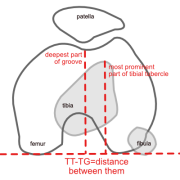
The finding implies that the poor alignment of the the tendon to the groove is stressing the patella. Calculation of the TT-TG distance is a normal part of the evaluation of a person with a painful or unstable kneecap.
Peer-reviewed paperQuote from peer-reviewed paper:
Citation: Vairo GL, Moya-Angeler J, Siorta MA, Anderson AH, Sherbondy PS. Tibial Tubercle-Trochlear Groove Distance Is a Reliable and Accurate Indicator of Patellofemoral Instability. Clin Orthop Relat Res. 2019 Jun;477(6):1450-1458. doi: 10.1097/CORR.0000000000000711. PMID: 31094842; PMCID: PMC6554121.
Discussion with patient regarding options for a maltracking patella.