Terminology of range of knee motion (ROM)
A straight leg is said to be at zero (0) degrees (ie zero degrees of flexion). Full flexion is normally about 135-143 degrees, depending on the muscle/fat bulk of the limb.
Although a straight knee is at 0 degrees, normally, a person can actually go beyond 0 degrees, and slightly 'hyper-extend', so full extension might be -6 degrees. This is very important in rehabilitation, because the last few degrees of extension are critical for knee stability. So when you are rehabilitation you need to get a measurement of your normal knee - both in flexion and extension - and use that as the desired range for the problem knee.
Quick linksThis video explains the terminology -
How is knee range of motion measured?
The simplest way to measure range of motion of the knee is with a plastic goniometer.
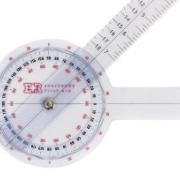
A plastic goniometer with longer arms is usually used to measure the range.
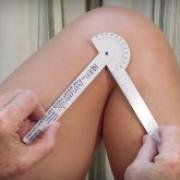
The scale part of the goniometer is placed on the joint line.
A 'goniometer' is a circular plastic disc marked out in degrees, with two long arms - one stationary and the other able to move. The centre of the disc is placed on the side of the knee at a bony reference point, and the one arm is pointed at the ankle while the other is pointed at the hip.
Two variants of ROM are usually measured during rehabilitation - the 'active' ROM - ie the range that the patient can achieve unaided, and the 'passive' ROM which is the range that can be achieved if the physiotherapist takes the knee through its motion.
What is the relevance of knee range of motion?
Sequential measurement of range-of-motion gives you a good idea of how knee rehabilitation is progressing in any one situation.
If the numbers are getting worse it implies that there is a problem with perhaps increasing fluid in the joint, or adhesions in the soft tissues around the joint.
Peer-reviewed paperQuote from peer-reviewed paper:
"Range of motion....is the most important outcome that defines the functional ability after total knee arthroplasty.... A minimum range of knee flexion of 90° is essential to daily activities with about 67° required in swing phase, 83° in climbing stairs, 90° in descending stairs, and 93° in rising from a chair"
Citation: Sancheti KH, Sancheti PK, Shyam AK, Joshi R, Patil K, Jain A. Factors affecting range of motion in total knee arthroplasty using high flexion prosthesis: A prospective study. Indian J Orthop. 2013 Jan;47(1):50-6. doi: 10.4103/0019-5413.106901. PMID: 23532488; PMCID: PMC3601234.