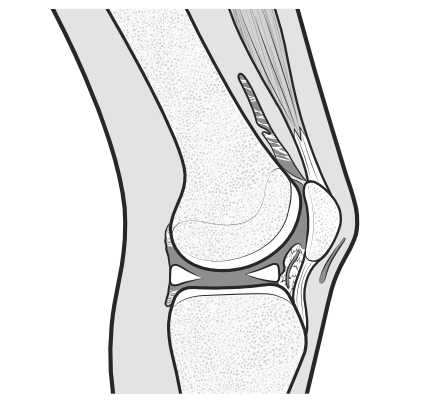
This illustration shows adhesions in the suprapatellar pouch, deep to the muscle group of the quadriceps. But adhesions can also form between the muscle heads making up the quads.
Quadricepsplasty is an open surgical procedure to release the rectus femoris part of the quadriceps muscle when adhesions have tied it down to the underlying vastus intermedius muscle. Page updated March 2024 by Dr Sheila Strover (Clinical Editor)
This illustration shows adhesions in the suprapatellar pouch, deep to the muscle group of the quadriceps. But adhesions can also form between the muscle heads making up the quads.
Adhesions are sticky strands that form between tissue layers in response to inflammation, where the body tries to heal neighbouring inflamed tissues by drawing them together. Arthrofibrosis is more advanced process where adhesions become replaced inappropriately with connective tissue, locking down a joint making movement difficult and painful.
Peer-reviewed papersQuote from peer-reviewed paper:
Citation: Xu H, Ying J. A mini-invasive procedure for treating arthrofibrosis of the knee. Acta Orthop Traumatol Turc. 2016 Aug;50(4):424-8. doi: 10.1016/j.aott.2016.06.006. Epub 2016 Jul 15. PMID: 27423809; PMCID: PMC6197392.
Distal quadricepsplasty is called Thompson's quadricepsplasty and is a paediatric procedure not appropriate for adult knees.
Peer-reviewed papersQuote from peer-reviewed paper:
Citation: Ding BTK, Khan SA. The judet quadricepsplasty for elderly traumatic knee extension contracture: a case report and review of the literature. Biomedicine (Taipei). 2019 Sep;9(3):21. doi: 10.1051/bmdcn/2019090321. Epub 2019 Aug 27. PMID: 31453802; PMCID: PMC6711318.
Quote from peer-reviewed paper:
Citation: Dos Santos Cerqueira F, T Araújo Motta GA, Rocha de Faria JL, Perez da Motta D, Dos Santos Cerqueira F, Adolphson F. Minimally Invasive Quadricepsplasty. Arthrosc Tech. 2019 Feb 25;8(3):e343-e347. doi: 10.1016/j.eats.2018.11.005. PMID: 31019888; PMCID: PMC6472174.
A spiral of surgical complications, with a Judet quadricepsplasty to remove adhesions.