 Photograph of the typical quadrant of the knee where the patient experiences dull pain, occasional sharp catching pain and the examiner can roll under the fingers a thickened tender band.
Photograph of the typical quadrant of the knee where the patient experiences dull pain, occasional sharp catching pain and the examiner can roll under the fingers a thickened tender band.
Photograph of the typical quadrant of the knee where the patient experiences dull pain, occasional sharp catching pain and the examiner can roll under the fingers a thickened tender band.
How does a plica become irritated?
A patient with symptoms suggestive of plica syndrome may remember a blunt injury like a direct blow or a fall on the knee, after which any repetitive stress - like descending steps - may trigger discomfort.
During arthroscopy it may be possible to visualise the thickened medial plica snapping over the femoral condyle, opening up a fissure of underlying damage to the cartilage surface at that exact point.
Peer-reviewed paperQuote from peer-reviewed paper:
"A diagnosis of....[synovial plica syndrome]....should be suspected in patients with intermittent pain, swelling, and snapping sensation affecting the knees, which is associated with activity that involves increased loading of the patellofemoral joint."
Citation: Lee PYF, Nixion A, Chandratreya A, Murray JM. Synovial Plica Syndrome of the Knee: A Commonly Overlooked Cause of Anterior Knee Pain. Surg J (N Y). 2017 Feb 15;3(1):e9-e16. doi: 10.1055/s-0037-1598047. PMID: 28825013; PMCID: PMC5553487.
The mechanism of medial plica trauma
In this illustration and arthroscopic photo you can see a medial plica being nipped between patella and femur during joint movement.
Above the knee a different synovial fold - the suprapatellar plica - may become nipped between the femur and the quadriceps tendon.
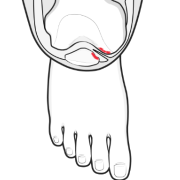
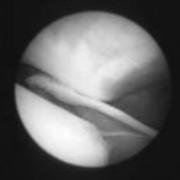
Photograph taken during keyhole surgery. As the plica thickens such nipping (catching) can occur more often.
Peer-reviewed paperQuote from peer-reviewed paper:
[However] "....direct contact between plicae and the patellofemoral joint is not necessary to cause symptoms as the tethering effect of a thickened plica might interfere with normal quadriceps function, placing excessive traction on its richly innervated synovial insertion."
Citation: Sauer S, Karlsen G, Miller L, Storm JO. Medial Plica Syndrome of the Knee: Arthroscopic Plica Resection versus Structured Physiotherapy-A Randomized Controlled Trial. Surg J (N Y). 2022 Sep 19;8(3):e249-e256. doi: 10.1055/s-0042-1756183. PMID: 36131946; PMCID: PMC9484868.
Management of Plica Syndrome
Different plicae can cause different symptoms - the common problematic plica is located on the medial (inner) aspect of the knee and it can become traumatised between the bones.
Treatment may includes anti-inflammatory medication, local steroid injection, physiotherapy to strengthen the quadriceps and hamstrings muscles and arthroscopic surgery to remove the structure entirely ('plicectomy').
Peer-reviewed paperQuote from peer-reviewed paper:
[However] "....In the presence of pathological plicae with cartilage damage of the femoral condyle or patella at the time of diagnostic arthroscopy, a plicectomy will be performed...."
Citation: Zmerly H, Moscato M, Akkawi I. Management of suprapatellar synovial plica, a common cause of anterior knee pain: a clinical review. Acta Biomed. 2019 Dec 5;90(12-S):33-38. doi: 10.23750/abm.v90i11-S.8781. PMID: 31821281; PMCID: PMC7233704.