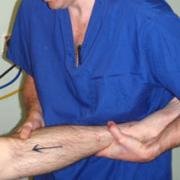
The pivot shift test is best performed under anaesthesia.
The pivot shift test is a test to assess the integrity of both the anterior cruciate ligament and and also the other key structures that contribute to the knee's stability. Page updated June 2024 by Dr Sheila Strover (Clinical Editor)
The pivot shift test is best performed under anaesthesia.
The examiner stands to the side of the knee, grasping the the ankle in one hand with the heel of the other hand behind the fibula head, with the hip flexed to 30 degrees and maintaining 20 degrees of internal tibial rotation. It is important to abduct the hip a bit to relax the iliotibial band.
The test is very subjective, and it takes experience to interpret confidently.
Quick links
But there is also a strong correlation between the more severe gradings on the pivot shift test and grade II and II injuries of the anterolateral ligament.
Peer-reviewed papersQuote from peer-reviewed paper:
Citation: Vaudreuil NJ, Rothrauff BB, de Sa D, Musahl V. The Pivot Shift: Current Experimental Methodology and Clinical Utility for Anterior Cruciate Ligament Rupture and Associated Injury. Curr Rev Musculoskelet Med. 2019 Mar;12(1):41-49. doi: 10.1007/s12178-019-09529-7. PMID: 30706283; PMCID: PMC6388573.
What that means is that it is testing for two things - the potential of the tibia to slip forwards in relation to the femur because of a cruciate ligament insufficiency, and also the potential of the tibia to rotate internally in relation to the femur because of an anterolateral ligament insufficiency.
The importance of identifying the rotational component is that in the past many anterior cruciate ligament reconstructions failed because the important contribution of the anterolateral ligament to knee joint stability was not appreciated.