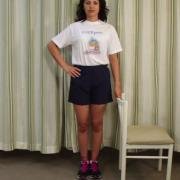

To abduct is to move the limb away from the midline, and towards the outer side, with the trunk upright. Page updated June 2024 by Dr Sheila Strover (Clinical Editor)
Quote from peer-reviewed paper:
Citation: Ueno R, Navacchia A, DiCesare CA, Ford KR, Myer GD, Ishida T, Tohyama H, Hewett TE. Knee abduction moment is predicted by lower gluteus medius force and larger vertical and lateral ground reaction forces during drop vertical jump in female athletes. J Biomech. 2020 Apr 16;103:109669. doi: 10.1016/j.jbiomech.2020.109669. Epub 2020 Jan 27. PMID: 32019678; PMCID: PMC7149737.
Thus one can measure the 'abduction moment', or the contribution to landing that is absorbed by the abductors of the knee. By measuring these various moments, the examiner can determine how balanced the muscles are. These measurements can predict to some extent the likelihood of any one athlete developing patellofemoral pain or tearing their anterior cruciate ligament.
Peer-reviewed papersQuote from peer-reviewed paper:
Citation: Myer GD, Ford KR, Di Stasi SL, Foss KD, Micheli LJ, Hewett TE. High knee abduction moments are common risk factors for patellofemoral pain (PFP) and anterior cruciate ligament (ACL) injury in girls: is PFP itself a predictor for subsequent ACL injury? Br J Sports Med. 2015 Jan;49(2):118-22. doi: 10.1136/bjsports-2013-092536. Epub 2014 Mar 31. PMID: 24687011; PMCID: PMC4182160.