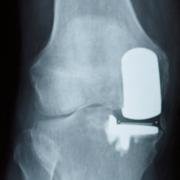
Tibiofemoral partial knee replacement, replacing one compartment of the joint.
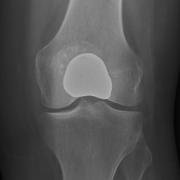
Hemicap patellofemoral replacement from the front.
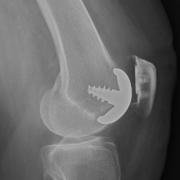
Hemicap patellofemoral replacement from the side
A partial knee replacement (or unicompartmental knee replacement) replaces one region (compartment) of the knee with a metal and plastic implant. Page updated July 2024 by Dr Sheila Strover (Clinical Editor)
Tibiofemoral partial knee replacement, replacing one compartment of the joint.
Hemicap patellofemoral replacement from the front.
Hemicap patellofemoral replacement from the side
Replacing the joint of any of these compartments is called a 'partial' or 'uni-compartmental' knee replacement.
It may also be called a unicompartmental knee replacement. This may be one or other of the two tibiofemoral joints (joint involving tibia and femur bones) or the single patellofemoral joint (between kneecap and femur bone).
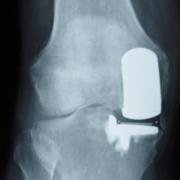
This is an X-ray showing a tibiofemoral partial knee replacement. The metal shows up as white, and the gap between the two metalllic bits is the plastic spacer (which does not show up on X-ray).
A metal component replaces the damaged trochlear groove of the femur, and a plastic button replaces the rear patellar surface which is cut away to accommodate the implant.
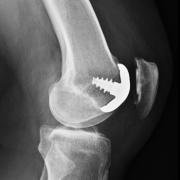
The trochlear implant is comprised of metal and shows up as white. The plastic patellar component is showing only as a space between the trochlear implant and the remainder of the patella.
Also the alignment of the limb should be good with frontal deformity of less than 15° and flexion contracture of less than 15°. The ligaments are the knee need to be uncompromised, especially the anterior cruciate ligament, and there should be no acute inflammatory process going on inside the knee. Finally, patients in general should be chosen from the middle-aged group, who would normally be considered too young for a knee replacement.
Update on unicompartmental knee arthroplastyVasso M, Antoniadis A and Helmy N. EFORT open reviews vol. 3,8 442-448.