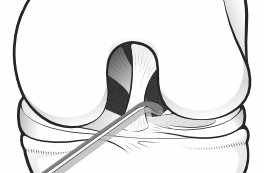
A probe being used to examine the integrity of the root area.
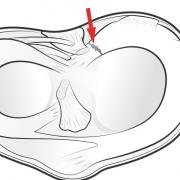
Looking down from the top, the illustration shows a radial tear through the body of the posterior horn of the meniscus at the root.
A meniscal root tear is a tear of the knee meniscus close to the root region where the meniscus is anchored to the underlying bone. Page updated December 2023 by Dr Sheila Strover (Clinical Editor)
A probe being used to examine the integrity of the root area.
Looking down from the top, the illustration shows a radial tear through the body of the posterior horn of the meniscus at the root.
At the front and the back of the meniscus anchoring fibres extend down into the flattened top of the tibia, fixing these ends but allowing the body of the meniscus to move, so that one can twist without stressing the meniscus.
A meniscal root tear is a serious incident. The meniscus itself is not initially damaged, but the sudden instability caused by the root issue needs to be addressed urgently or else the excessive mobility of the meniscus will lead to it becoming irreparably damaged.
Meniscus root tears may be acute, where the tear occurs suddenly and is immediately associated with incompetence of the meniscus as a shock absorber.
In older people it may only be recognised when investigation of arthritis symptoms reveal a meniscal extrusion, with the meniscus slipping out over the edge of the tibia bone. Either situation may end up with the patient developing arthritis, but early recognition of an acute tear may result in referral to a specialist meniscus surgeon, and repair of the tear before arthritis is established.
Meniscal root tears are classified as Types 1-5 depending on the situation and extent of the tear.
Reference: LaPrade classification system of meniscal root tears
Patients discuss complete radial tear of the meniscus and compare this with meniscal root tears.
Quote:
Citation: Pache S, Aman ZS, Kennedy M, Nakama GY, Moatshe G, Ziegler C, LaPrade RF. Meniscal Root Tears: Current Concepts Review. Arch Bone Jt Surg. 2018 Jul;6(4):250-259. PMID: 30175171; PMCID: PMC6110430.