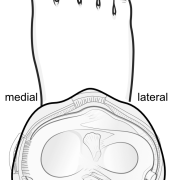
Illustration looking down on the top of the tibia bone, with the femur cut away, to show the menisci seated on the tibial plateau.
The lateral meniscus is the crescentic wedge-shaped structure seated on the top of the tibia (shinbone) on the lateral (outer) side of the knee joint. Page updated June 2024 by Dr Sheila Strover (Clinical Editor)
Illustration looking down on the top of the tibia bone, with the femur cut away, to show the menisci seated on the tibial plateau.
It is O-shaped, rather than C-shaped, and is much more mobile than the medial meniscus and there is much less attachment around the outer rim to the capsular walls. In addition, the tendon of the popliteus muscle passes between the outer rim at the back of the meniscus and the capsule.
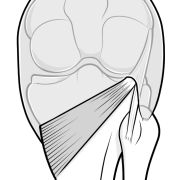
This illustration is from the back of the knee, looking at how the tendon of the popliteus muscle on the lateral side pierces the capsule and passes alongside the lateral meniscus on its way to insert on the femur. There is no equivalent on the medial side.
This complex area is called the 'posterolateral corner'. Injuries here may be a challenge to the surgeon.
Quick linksBoth are packed with fibres which are arranged in a structured network which makes the structures strong and help them avoid stress tears. The wedge-shape, and the presence of ligamentous attachments to the underlying tibia bone, help to stabilise the joint.
Peer-reviewed papersQuote from peer-reviewed paper:
Citation: Zhang S, Chen G, Li R, Yang C, Zheng J, Wang C, Lu J, Zhang Z, Shang X, Zhang H, Wang W, Li W, Huang J, Zhang Y, Wang J, Wang Y, Zheng X, Chen S, Li J, Hua Y. Guidelines on the Diagnosis and Treatment of Lateral Meniscal Lesions: A Consensus Statement by the Chinese Society of Sports Medicine. Orthop J Sports Med. 2022 Dec 9;10(12):23259671221138082. doi: 10.1177/23259671221138082. PMID: 36532151; PMCID: PMC9747892.
The person may develop some bowing of the knee compared to the other side, and experience uncomfortable instability.
The high mobility, the weaker outer rim and the poorer attachment to the capsule render it prone to instability once it is injured.
The clinician must be sure to exclude other conditions that may mimic a lateral meniscus tear.
Peer-reviewed papersQuote from peer-reviewed paper:
Citation: Barker JU, Strauss EJ, Lodha S, Bach BR Jr. Extra-articular Mimickers of Lateral Meniscal Tears. Sports Health. 2011 Jan;3(1):82-8. doi: 10.1177/1941738110385997. PMID: 23015995; PMCID: PMC3445190.
A personal story of a patient who's joint surfaces were under stress because of serious damage to the lateral meniscus.
A young mother is struggling after partial lateral meniscectomy