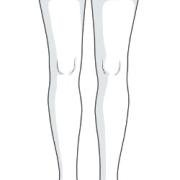
With external tibial torsion, when the kneecaps are facing forwards, the feet are rotated outwards.
With internal tibial torsion, when the feet are both facing forwards the kneecaps are 'squinting' inwards.
Tibial torsion is a condition where the tibia bone is abnormally twisted, often leading to problems with kneecap pain. Page updated May 2024 by Dr Sheila Strover (Clinical Editor)
With external tibial torsion, when the kneecaps are facing forwards, the feet are rotated outwards.
With internal tibial torsion, when the feet are both facing forwards the kneecaps are 'squinting' inwards.
In small children 'in-toeing' is common. Most children will go on to have normal tibias but in a small percentage the rotational deformity unfortunately persists through into adulthood.
Usually adult rotational tibial deformity causes a pidgeon-toed gait, but sometimes it is the opposite and the feet turn outwards (external tibial torsion).
Quick linksThe torsion may lead to patellofemoral pain and patellar instabillity.
Peer-reviewed papersQuote from peer-reviewed paper:
Citation: Snow M. Tibial Torsion and Patellofemoral Pain and Instability in the Adult Population: Current Concept Review. Curr Rev Musculoskelet Med. 2021 Feb;14(1):67-75. doi: 10.1007/s12178-020-09688-y. Epub 2021 Jan 8. PMID: 33420589; PMCID: PMC7930175.
But when it persists into young adulthood management is generally one of 'wait and see'. Orthotics may be helpful and physiotherapy will focus on balancing muscle strength around the knee.
If the torsion leads to symptoms in the young adult, then a de-rotation osteotomy may be the only real solution.
Quick links