
Osteoarthritis of the knee is the most common form of knee arthritis. Page updated January 2024 by Dr Sheila Strover (Clinical Editor)
Osteoarthritis begins with breakdown of the joint cartilage at the ends of the bones. Classical symptoms include pain at rest, reduced exercise tolerance, joint swelling and eventual joint deformity.
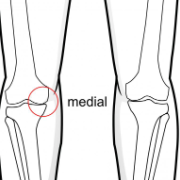
Usually knee osteoarthritis begins in one part of the knee (what we call a 'compartment'), such as the contact area between femur and tibia on the one side. Only later does it tend to progress to involve the other compartments. This gives the patient the option to try to arrest progression by suitable intervention, such as wearing an unloader brace or having a uni-compartmental knee replacement.
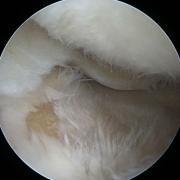
Grade IV damage
Keyhole surgery is not indicated, but if you look inside the joint you would see damage to the usually silky joint cartilage breakdown.
Classical imaging signs include joint line narrowing, bone spurs, bone cysts and areas of increased bone density (sclerosis).
The bones of the knee actually have three areas of articulation, not one. The two rounded condyles of the femur make articulate separately with the flattened tibia. The kneecap or patella has a third area of articulation with the femur. Each of these is really a separate 'joint', which we call a 'compartment'. Arthritis may initiate at different times in these compartments, depending upon those factors that have triggered it off, such as a damaged meniscus just on the one side.
So it is helpful if the surgeon can intervene and improve function in the one compartment, before the changed mechanics of the knee causes arthritis to affect the other compartments also.
Doctors tend to take different approaches in the management of osteoarthritis depending on their particular line of interest - a general practitioner may tend to look at general factors such as weight and diet, a rheumatologist may prescribe anti-inflammatories, including steroids, and knee surgeons tend to take a mechanical approach and try and sort out any structural problems.
Early osteoarthritis is managed conservatively with anti-inflammatory medications, removal of fluid in the joint and injections into the knee. As deformity progresses, minor procedures might be performed, such as removal of bone spurs, but later deformities may be indications for osteotomy, unicompartmental knee replacement or total knee replacement.
Quote:
Citation: Lespasio MJ, Piuzzi NS, Husni ME, Muschler GF, Guarino A, Mont MA. Knee Osteoarthritis: A Primer. Perm J. 2017;21:16-183. doi: 10.7812/TPP/16-183. PMID: 29035179; PMCID: PMC5638628.