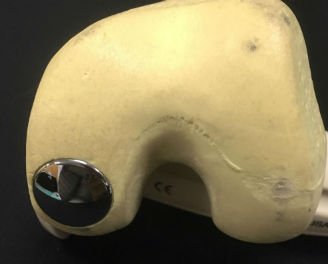

A focal implant is an artificial implant of metal or plastic that replaces a small and discrete area of damaged joint surface. Page updated October 2023 by Dr Sheila Strover (Clinical Editor)
Younger patients may instead be offered a biological solution such as autologous chondrocyte implantation (ACi) and older patients might be offered a knee replacement, but in between these two age groups a focal implant appears to have a significant role. Another indication - where younger patients may be considered - is if there is bone oedema associated with the cartilage damage, in which case any biological solution might fail.
A focal implant replaces a small part of a joint surface with an uncemented prosthesis made of cobalt-chrome, leaving the rest of the joint cartilage functioning as normal. Focal implants are much smaller than total or partial knee replacements. A focal implant may prevent further damage in a way analogous to a dental filling, providing an alternative to a joint replacement. Results of using a focal implant may be comparable to a biological implant, but there are cost and time savings.
Focal implants are available for the convex femoral condyles and also for the concave patello-femoral groove where the patella glides. They are appropriate in the middle age group for areas where damage is localised with healthy opposing cartilage surfaces, the mechanical alignment of the joint is good and meniscal function is not seriously compromised.
Quote:
Citation: Holz J, Spalding T, Boutefnouchet T, Emans P, Eriksson K, Brittberg M, Konradsen L, Kösters C, Verdonk P, Högström M, Lind M. Patient-specific metal implants for focal chondral and osteochondral lesions in the knee; excellent clinical results at 2 years. Knee Surg Sports Traumatol Arthrosc. 2021 Sep;29(9):2899-2910. doi: 10.1007/s00167-020-06289-7. Epub 2020 Oct 6. PMID: 33025052; PMCID: PMC8384793.