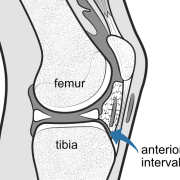
A normal anterior interval allows free movement of the fat pad, meniscus and patellar tendon.
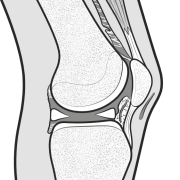
Arthrofibrosis may 'gum' down mobile tissues, including the anterior interval, with adhesions, with consequent reduced range of motion of the knee.
Anterior interval arthrofibrosis is the condition of abnormal scarring in the 'anterior interval' - the space below the kneecap and behind the patellar tendon. Page updated June 2023 by Dr Sheila Strover (Clinical Editor)
A normal anterior interval allows free movement of the fat pad, meniscus and patellar tendon.
Arthrofibrosis may 'gum' down mobile tissues, including the anterior interval, with adhesions, with consequent reduced range of motion of the knee.
Once the anterior interval is stuck down with arthrofibrosis any effort to bend the knee results in excruciating pain. This may surprise patient and therapist and result in the patient being pushed ever harder to re-gain range of motion - a vicious cycle...
Peer-reviewed papersQuote from peer-reviewed paper:
Citation: Lee DR, Therrien E, Song BM, Camp CL, Krych AJ, Stuart MJ, Abdel MP, Levy BA. Arthrofibrosis Nightmares: Prevention and Management Strategies. Sports Med Arthrosc Rev. 2022 Mar 1;30(1):29-41. doi: 10.1097/JSA.0000000000000324. PMID: 35113841; PMCID: PMC8830598.
Under anaesthesia, the surgeon will introduce radiofrequency instruments into the knee cavity, passing the instrument down under the intermeniscal ligament and into the area behind the patellar tendon. When the instrument is turned on, the adhesions 'melt'.
Quick links