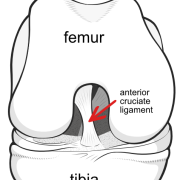
View of ACL from the front of the bended knee. The anterior cruciate ligament is one of the two large ligaments which cross over each other right inside the knee joint notch.
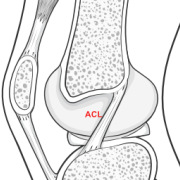
View of the ACL from the side, with the knee cut in half.
ACL is an abbreviation for 'anterior cruciate ligament'. Page updated June 2024 by Dr Sheila Strover (Clinical Editor)
View of ACL from the front of the bended knee. The anterior cruciate ligament is one of the two large ligaments which cross over each other right inside the knee joint notch.
View of the ACL from the side, with the knee cut in half.
They tether the tibia to the femur in such a way as to allow bending and straightening while preventing forwards and backward movements of the two bones in relation to one another.
Peer-reviewed papersQuote from peer-reviewed paper:
Citation: Shom P, Varma AR, Prasad R. The Anterior Cruciate Ligament: Principles of Treatment. Cureus. 2023 Jun 11;15(6):e40269. doi: 10.7759/cureus.40269. PMID: 37448400; PMCID: PMC10336184.
The former is more common in adults, and the latter is more common in children. An ACL injury is very disabling and usually the person is immediately unable to continue with the activity that caused it. It is often acompanied by immediate joint swelling due to bleeding into the joint capsule (haemarthrosis), and the knee generally feels unstable when trying to bear weight.
Peer-reviewed papersQuote from peer-reviewed paper:
Citation: Shom P, Varma AR, Prasad R. The Anterior Cruciate Ligament: Principles of Treatment. Cureus. 2023 Jun 11;15(6):e40269. doi: 10.7759/cureus.40269. PMID: 37448400; PMCID: PMC10336184.
The examiner will position the patient optimally, and then pull against the tibia, looking for excessive anterior translation.
The Lachman, pivot shift test and Slocum test are all also relevant.
Quick linksThis condition is rare.
Peer-reviewed papersQuote from peer-reviewed paper:
Citation: Lu R, Zhu DP, Chen N, Sun H, Li ZH, Cao XW. How should congenital absence of cruciate ligaments be treated? A case report and literature review. World J Clin Cases. 2019 Oct 6;7(19):3082-3089. doi: 10.12998/wjcc.v7.i19.3082. PMID: 31624758; PMCID: PMC6795736.
Quote from peer-reviewed paper:
Citation: Benassi AB, Guerreiro JPF, de Oliveira Queiroz A, Gasparelli RG, Danieli MV. Anterior and posterior cruciate ligament agenesis. J Surg Case Rep. 2018 Aug 15;2018(8):rjy216. doi: 10.1093/jscr/rjy216. PMID: 30151108; PMCID: PMC6101568.
A youth soccer coach is astonished to find that some people are born without cruciate ligaments.
A more detailed discussion about the problems people face who are born without ACLs.
Discussion involving skiers about the merits or otherwise of initially following a conservative route after ACL injury in the hope that stability can be achieved without surgery.
Another discussion about making the decision to proceed to reconstructive surgery after ACL injury.